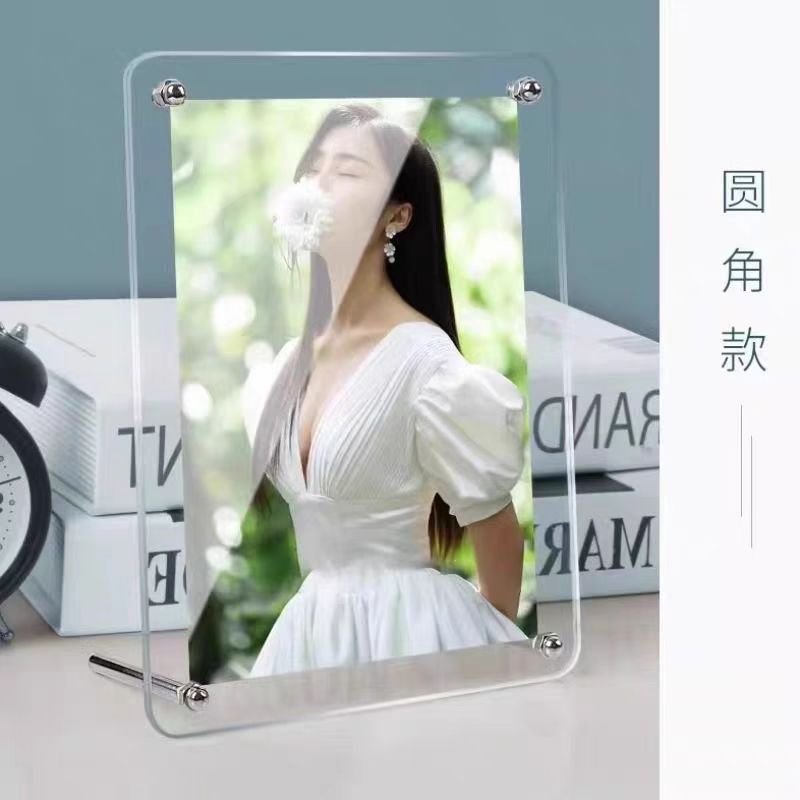
Product Description
Introduction to UV Printing of Acrylic Photo Frame
core principle
Acrylic (PMMA, organic glass) itself has a light transmittance of up to 92%, while UV printing involves spraying UV ink directly onto the surface of acrylic through a piezoelectric nozzle, and then curing it instantly through an LED ultraviolet lamp (about 365nm), allowing the liquid resin to crosslink into a film within milliseconds. After the ink solidifies, it firmly adheres to the surface of acrylic, with full color and strong weather resistance. It can be used outdoors for 5-8 years without fading.
Two mainstream printing processes
Applicable scenarios for visual effects of process methods
Directly spray high-definition color images on the front of acrylic with a 3D relief touch, which can be overlaid with gloss oil to enhance wear resistance, decorative paintings, medals, and creative ornaments
The back spray pattern is sprayed on the back of the acrylic, and the smooth touch of the acrylic is retained on the front for viewing. The thickness of the board is used to create a depth of field effect, and the picture has a more vertical sense of high-end decorative paintings, brand displays, and hotel/restaurant space embellishments
Compared to the core advantages of screen printing
Comparison Dimension UV Printing Screen Printing
Gradient color/photo grade image ✅ Easy implementation, natural color transition ❌ Difficult to restore, limited color accuracy
The cost of plate making does not require a Philippine web version, and each color needs to be made separately when there is a drawing file. The minimum printing volume requirement is high
The number of colors can be molded in one go, with no limit on the number of colors. The more colors there are, the higher the cost
Special effects support 3D relief, matte, flash, and other colors such as fluorescent, metallic, and pearl
Adhesion (acrylic surface) requires spray coating+gloss oil protection, overall slightly inferior. After ink curing, the adhesion is stronger and more scratch resistant
The uniformity of large-area solid color is slightly inferior to silk screen printing ✅ Very uniform
Small batch/personalized ✅ Single piece printing, can be taken immediately ❌ uneconomical
Summary in one sentence: To choose gradient, photo, and small batch customization ->select UV printing; To have a large area of solid color, to be extremely wear-resistant, and to have a large quantity → choose silk screen printing.
Key technical parameters
Indicator values
Printing accuracy of 1200-1440 dpi, 0.1mm fine lines can be clearly restored
Curing speed: After the ink is sprayed, it solidifies instantly, truly "instantly achievable"
The thickness adaptation of the board is usually 3-8mm, and some equipment supports a drop of 20-30mm
Color mode CMYK+white ink base (essential for transparent/dark acrylic)+spot color optional
Common application scenarios
Commercial signage: signage, corporate image wall, lightbox advertising, menu board
Creative Gifts: Personalized Medals, Wedding Invitations, Refrigerator Stickers, Plaques, Souvenirs
High end space: hotel decoration paintings, restaurant menus, brand cultural walls, wedding photography studio photo frames
Imaging products: wedding photos, artistic micro spray, customized photo frames
Three key points for success or failure in production
Clean environment: Acrylic is highly susceptible to dust collection, and must be wiped with a dust-free cloth before printing to prevent white spots and graininess
Coating treatment: UV ink has weak adhesion on smooth acrylic, so a special coating must be sprayed first, then printed, and finally coated with gloss oil
Calibration of nozzle spacing: Excessive blurring and insufficient ghosting directly affect the accuracy of the finished product
Error remedy tips
Discovery of time processing methods
Immediately detect alcohol spray → wipe with a soft cloth, can be directly remade
Soak in alcohol for about 30 minutes within 12 hours, and the pattern can be peeled off
If it exceeds 24 hours, it needs to be cleaned with professional solvents such as hydrogen peroxide/banana oil