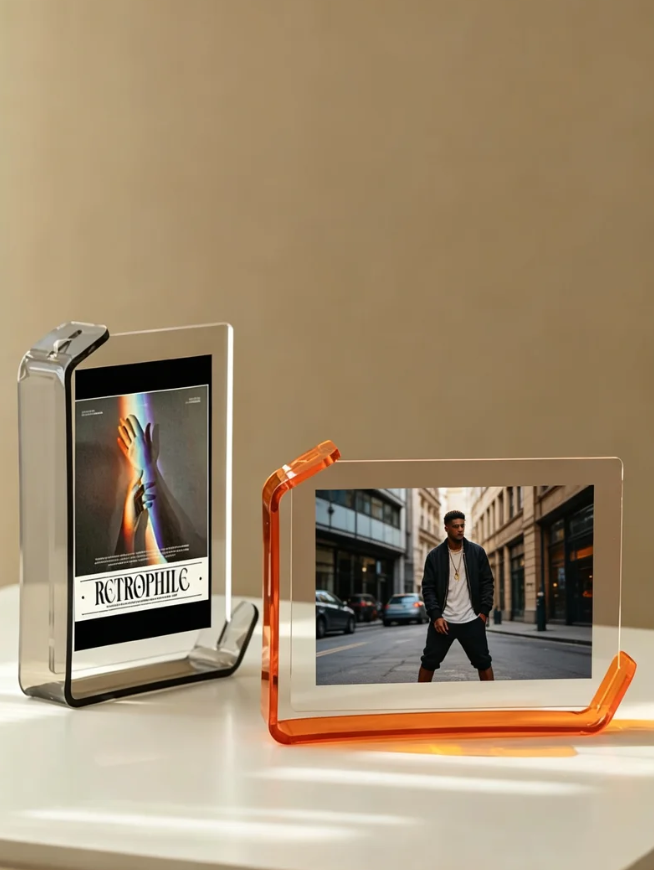
Product Description
Introduction to Cutting Methods for Acrylic Mirrors
Acrylic mirrors (also known as acrylic mirrors or PMMA lenses) have a coating layer (aluminum/silver, etc.) on the back. When cutting, it is necessary to balance substrate accuracy and back coating protection, which requires higher requirements than ordinary acrylic sheets. There are four common cutting methods:
1、 Laser cutting (highest precision, most recommended)
Project Description
Principle: CO ₂ laser focuses energy on a small area to melt/vaporize materials
Suitable for any complex shape with minimal material waste
The recommended thickness limit is ≤ 6mm, as edges exceeding this thickness are prone to beveled edges
Speed reference 1200W laser, about 200W power, can reach 200 inches/minute
The key requirement is that the speed and light intensity must match, otherwise there will be burn marks and burrs on the edges
Special note:
The mirror should be placed facing downwards to avoid direct damage to the mirror layer by the laser
Suggest adding protective film or backing paper to prevent carbonization and foaming of the back coating
After cutting, it is recommended to perform annealing treatment to eliminate stress (especially when bonding is required later)
PMMA smoke generation requires exhaust or air purification devices
2、 Circular saw/chainsaw linear cutting (fastest speed)
Project Description
Suitable for straight cutting of single or multiple sheets, with the highest efficiency
Placement method: Mirror facing downwards, with a protective film sandwiched between every two boards to protect the back plating layer
Recommended saw blade is a 10 inch, 80 tooth hard alloy blade with a three tooth design and a clearance angle of 10 °~15 °
Auxiliary measures: Install reinforcing ribs (diameter 1/2~2/3) on the outer side of the saw blade to reduce vibration
Key safety points for electric saw cutting:
Protective goggles+gloves+mask (mandatory)
The workpiece must be firmly fixed to prevent movement
The speed should not be too fast to avoid overheating and causing acrylic to melt
Can spray water for cooling, but avoid water entering the chainsaw
Maintain a constant speed and advance in a straight line
3、 CNC precision carving and cutting
Project Description
Principle: Cut according to the input graphic using a cutting tool, similar to a laser but with a milling cutter
The accuracy is not as good as laser cutting, and the edges are rougher
Disadvantages: There are many residues and significant material waste
Suitable for carving text/patterns (without cutting through), or scenes with low requirements for edges
4、 Manual marking and cutting (simplest, suitable for thin plates)
Project Description
Suitable for single piece acrylic mirrors with a thickness<3mm, only for straight cutting
Tool hook knife (marking tool)+ruler guide
Step 1: Use a hook knife to repeatedly draw a line along the ruler until the thickness of the board is 1/2~1/3 → ② Place one end on the table and the other end suspended → ③ Break along the scratch → ④ Polish the edge with sandpaper
Advanced technique: Stack 3-4 new blades and use the back of the blade tip to draw a line for neater alignment; After cutting, you can use a hair dryer to heat it up and then bend it more straight
Quick comparison of cutting methods
Method, accuracy, speed, cost, applicable scenarios
laser cutting ⭐⭐⭐⭐⭐ Medium to high complexity shapes, high precision requirements
Circular saw cutting ⭐⭐⭐⭐ Fastest low line batch cutting
CNC cutting ⭐⭐⭐ Slow carving/text/patterns
manual cutting ⭐⭐ Slow minimum thin plate simple straight line
General precautions
Fixation is the top priority - any shaking can cause cutting deviation or breakage
The mirror always faces downwards - protecting the back coating from damage
Polish the edges after cutting - remove burrs to prevent cutting hands and affect aesthetics
Acrylic should not come into contact with organic solvents. Only use 1% soapy water and a soft cloth for cleaning
The working environment needs ventilation to reduce dust and odors